Concrete driveways in Citrus County rarely last a decade. Here's why pavers hold up better — and what to know before you choose.
Share:
Summary:
Most homeowners in Citrus County don’t start thinking about driveway pavers because they want something prettier. They start thinking about them because their concrete driveway is falling apart — and they’re tired of patching it. The cracks come back. The stains set in. A tree root pushes up a section near the garage, and suddenly you’re looking at a trip hazard instead of a driveway.
If that sounds familiar, you’re in the right place. This page will walk you through how paver driveways actually work, why they hold up so much better in this specific part of Florida, and what to look for in a contractor before you hand anyone a deposit.
Poured concrete is designed to be rigid. That’s fine in stable soil — but Citrus County doesn’t have stable soil. The sandy, karst-limestone substrate that runs through Homosassa, Crystal River, Inverness, and Beverly Hills shifts with moisture, expands in the heat, and compresses under load. Concrete fights that movement. Pavers work with it.
Each interlocking paver unit is independent. When the ground shifts slightly beneath them — and in this county, it will — the pavers flex and adjust rather than fracturing. That’s the core mechanical reason why a well-installed paver driveway routinely lasts 30 to 50 years in Citrus County, while a concrete slab often shows its first cracks within three to five.
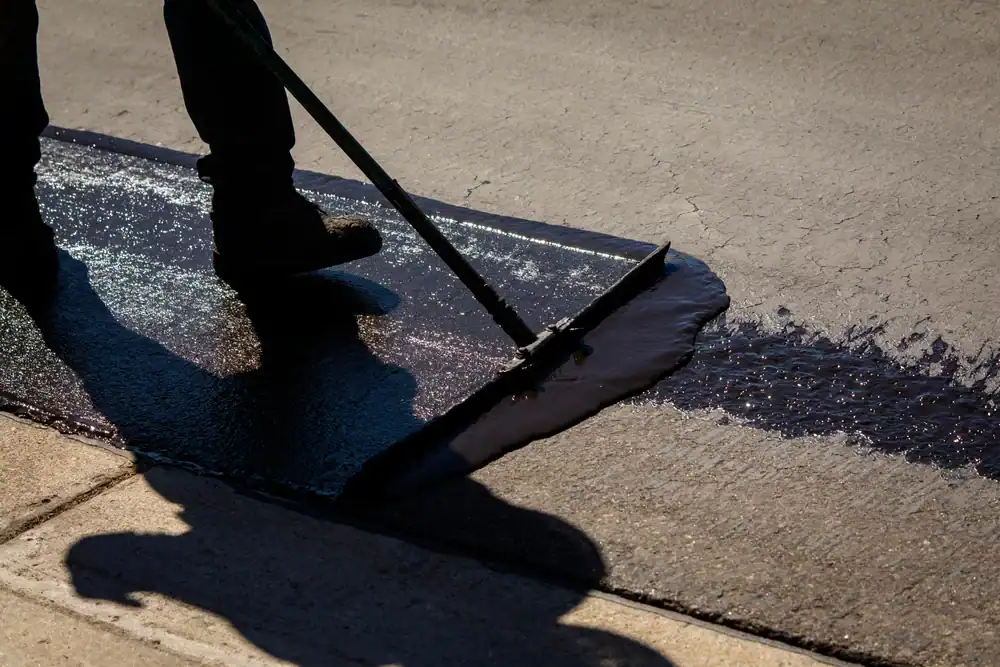
Three things accelerate concrete failure in Citrus County faster than almost anywhere else in the state: tree roots, heavy rainfall, and summer heat.
The Live Oaks, Sabal Palms, and Southern Magnolias that give this area its character also have aggressive root systems that push through concrete slabs from below. Once a root finds a weak point — and concrete always has weak points — the damage spreads fast. With a paver driveway, that same problem has a completely different outcome. You lift the affected pavers, address the root, and reset them. No jackhammer. No full slab replacement. Just a targeted repair that leaves the rest of the driveway untouched.
Rainfall is the other major factor. Citrus County gets over 50 inches of rain a year, most of it concentrated between June and September. Concrete sheets water off — toward your garage, your foundation, your landscaping. The joint system in a properly installed paver driveway allows water to percolate through rather than pool and redirect. For homeowners near the Homosassa River or in low-lying areas around Crystal River, that drainage difference is significant.
Then there’s the heat. A concrete surface in a Florida July can reach 150°F. That kind of thermal cycling — expanding in the afternoon, contracting at night — accelerates surface degradation over time. Lighter-colored pavers and natural stone options stay noticeably cooler and hold up better under that daily stress.
None of these are abstract concerns. They’re the specific conditions your driveway faces every single year in this county. Pavers are engineered to handle all three. Concrete, over time, is not.
The finished surface is the part everyone sees. The base is the part that determines whether your driveway lasts five years or fifty. This is where most installations go wrong — and where most homeowners have no way of knowing the difference until it’s too late.
A proper installation starts with excavation. Not a shallow scrape, but a real dig — removing unstable soil and organic material down to a stable subgrade. On top of that goes a minimum of six inches of compacted aggregate base, installed in layers and compacted between each one. This is the structural foundation of the entire driveway, and it’s the step that low-bid contractors routinely cut because you can’t see it once the pavers are down. We don’t cut it, because we’ve seen what happens to driveways where someone did.
After the base comes a one-inch bedding layer of coarse sand, which gives the pavers a consistent, level setting surface. Then the pavers themselves are laid in the chosen pattern, cut precisely at borders and angles, and locked in place with edge restraints that prevent outward spreading over time. Polymeric joint sand is swept into the joints and compacted — it hardens to resist weed germination, insect activity, and washout. Finally, the surface is sealed.
That sealing step matters more than most people realize. In Citrus County’s UV environment, unsealed pavers fade and lose their color within a few years. A proper sealer locks in the joint sand, repels oil and stains, and protects the surface against the kind of UV degradation that makes a driveway look ten years older than it is.
We’re authorized contractors for Tremron, Belgard, and Flagstone — three of the top paver manufacturers in the country. We install to each manufacturer’s specific standards. That means the product warranties are actually honored, because the installation meets the requirements behind them.
Want live answers?
Connect with a MainStreet Landscaping expert for fast, friendly support.
The upfront number is the one that stops most people. Paver driveways typically run $15 to $30 per square foot installed, while poured concrete comes in around $8 to $15. On a standard two-car driveway, that’s a real difference — and it’s worth being honest about.
What’s also worth being honest about is what happens after installation. Concrete driveways require ongoing patching, periodic resurfacing, and eventual full replacement. Pavers require periodic resealing and the occasional joint sand refresh. When you run the math over 20 years, pavers consistently come out ahead — often significantly. The upfront premium tends to pay for itself well before the halfway mark.
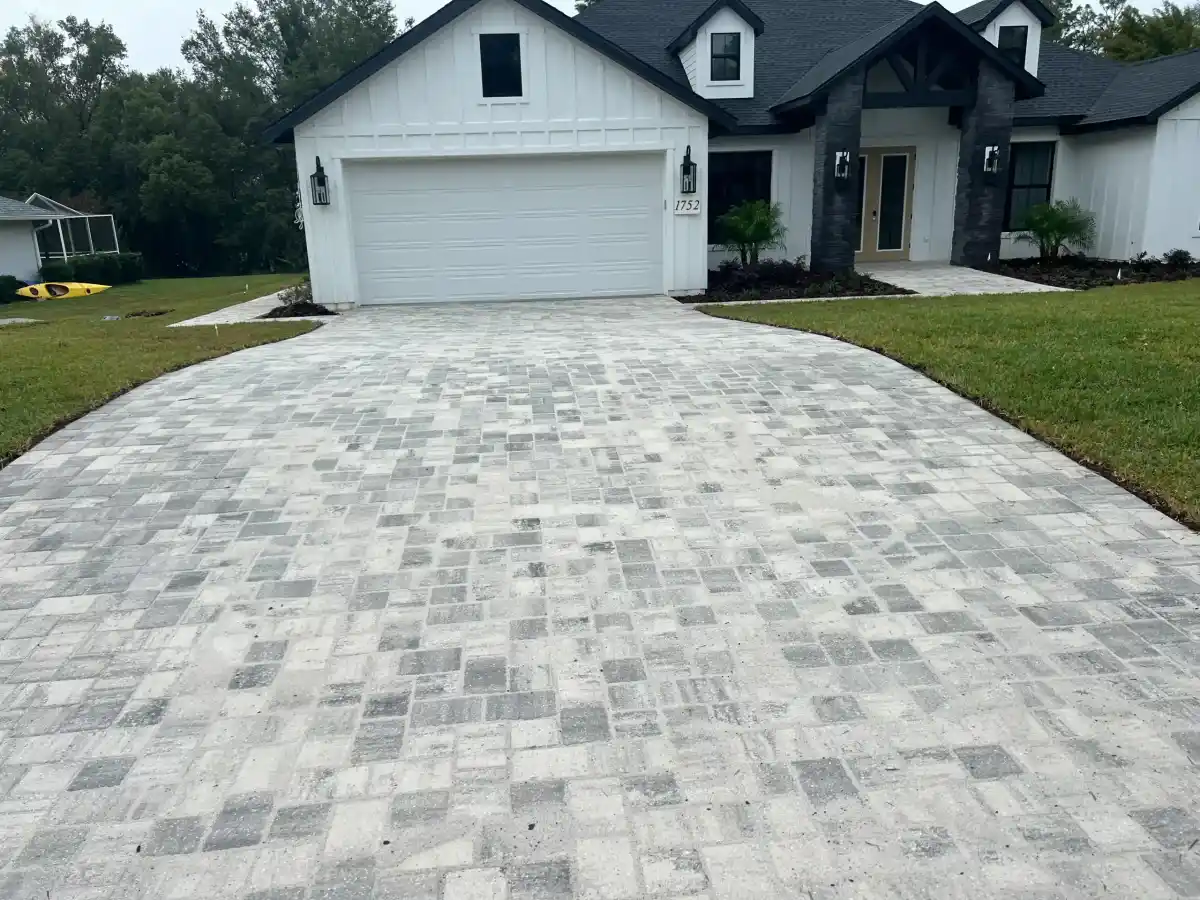
This comes up constantly, and it’s worth addressing directly: no. Installing pavers over existing concrete is one of the most common mistakes in this industry, and it’s usually framed as a cost-saving move. It isn’t.
The entire structural advantage of an interlocking paver system depends on its ability to flex with the ground beneath it. When you install pavers over a rigid concrete slab, you eliminate that flexibility entirely. The pavers can’t move independently. The concrete beneath them still cracks and shifts the way it always did. You end up with a surface that looks like a paver driveway but performs like a failing concrete one — with the added cost of the pavers on top.
The right approach is to remove the existing concrete first, properly prepare the base, and build the paver system from the ground up. That’s more work upfront, but it’s the only way to get the longevity and performance that make pavers worth the investment in the first place.
We’ve seen plenty of driveways in Citrus County where a previous contractor took the shortcut. The homeowners come to us a few years later with shifting, uneven surfaces and no good options. Doing it right the first time is always less expensive than doing it twice.
A few questions come up in almost every conversation we have with homeowners here, and they’re worth answering plainly.
One of the most common is about weeds. People picture a paver driveway turning into a garden between the joints, and it’s a reasonable concern. With properly installed polymeric joint sand and a quality sealer, weed growth is dramatically suppressed. The joint sand hardens and creates a barrier that most weed seeds can’t penetrate. We’re the exclusive Seal ‘n Lock distributor in Citrus County — no other contractor here offers that specific product — and it’s one of the most effective joint protection systems available. Competitors simply can’t match it locally.
Another question we hear often is about repairs. What happens if a paver cracks or shifts? The answer is one of the clearest advantages pavers have over concrete: you lift the affected unit, fix whatever caused the issue, and set it back. The surrounding driveway stays completely intact. There’s no patching compound, no visible seam, no section that looks different from the rest. That repairability is especially valuable in Citrus County, where tree roots and soil movement are ongoing realities, not one-time events.
People also ask how long the project takes. A standard residential driveway typically takes three to seven days from start to finish, depending on size and complexity. Unlike concrete, which requires a seven-day cure before you can drive on it, a paver driveway is ready to use the same day installation is complete.
Finally, homeowners in communities like Citrus Hills and Beverly Hills often ask whether pavers can meet HOA aesthetic requirements. The short answer is yes — and usually better than concrete can. Because we’re authorized by Tremron, Belgard, and Flagstone, we have access to a wide range of colors, textures, and patterns. If your HOA has specific standards, we can almost certainly find an option that satisfies them and looks exactly the way you want it to.
The driveway itself is only as good as the installation behind it. A properly built paver driveway in Citrus County will outlast concrete by decades, handle the soil movement and rainfall this area throws at it, and look better doing it. But that outcome depends entirely on who installs it and how they build the base — the part you’ll never see once the job is done.
We’ve been doing this work in Citrus County since 1995. That’s nearly 30 years of driveways, patios, pool decks, and outdoor spaces built for the specific conditions here — the sandy soil, the Live Oak roots, the rainy seasons, the heat. We know what holds up and what doesn’t, because we’ve watched both play out over time in this community.
If you’re ready to stop patching and start planning, reach out to us. We’ll walk you through the options, give you honest numbers, and show you exactly what the process looks like from the first dig to the final seal.
Article details:
Share:
Continue learning: