Florida's fall outdoor season starts in October — and if your patio isn't ready, you'll miss the best months of the year. Here's how to get ahead of it.
Share:
Summary:
Here’s something most people get wrong about outdoor living in Florida: they treat it like a summer project. They plan in spring, install in summer, and then wonder why the timing always feels rushed.
In Citrus County, fall is the season. October highs around 84°F, lows in the mid-60s, humidity that finally backs off, and the kind of evenings where a fire pit actually makes sense — that’s when your outdoor space earns its keep. But getting there takes a little planning before the season arrives.
Whether your patio needs a full refresh after a rough rainy season or you’ve been putting off building one entirely, here’s what you need to know to make the most of Citrus County’s best months.
Good patio design in Florida isn’t just about how it looks — it’s about how it holds up. The combination of sandy soil, heavy summer rains, intense UV exposure, and the occasional tropical storm creates conditions that punish shortcuts.
A patio that looks great in photos but was built on a rushed base won’t make it five years without settling, cracking, or growing weeds between every joint. The design choices that matter most here are the ones you can’t see after installation: proper excavation depth, base compaction suited to Citrus County’s sandy soil, edge restraints that prevent lateral movement, and drainage that accounts for the volume of water this region gets from June through September.
Get those right, and the aesthetic choices — material, color, pattern, layout — are the fun part.

The most common mistake homeowners make with backyard patio design is thinking in terms of a single slab of surface area. A well-designed outdoor space functions more like a room — with distinct zones for different activities that flow naturally into each other.
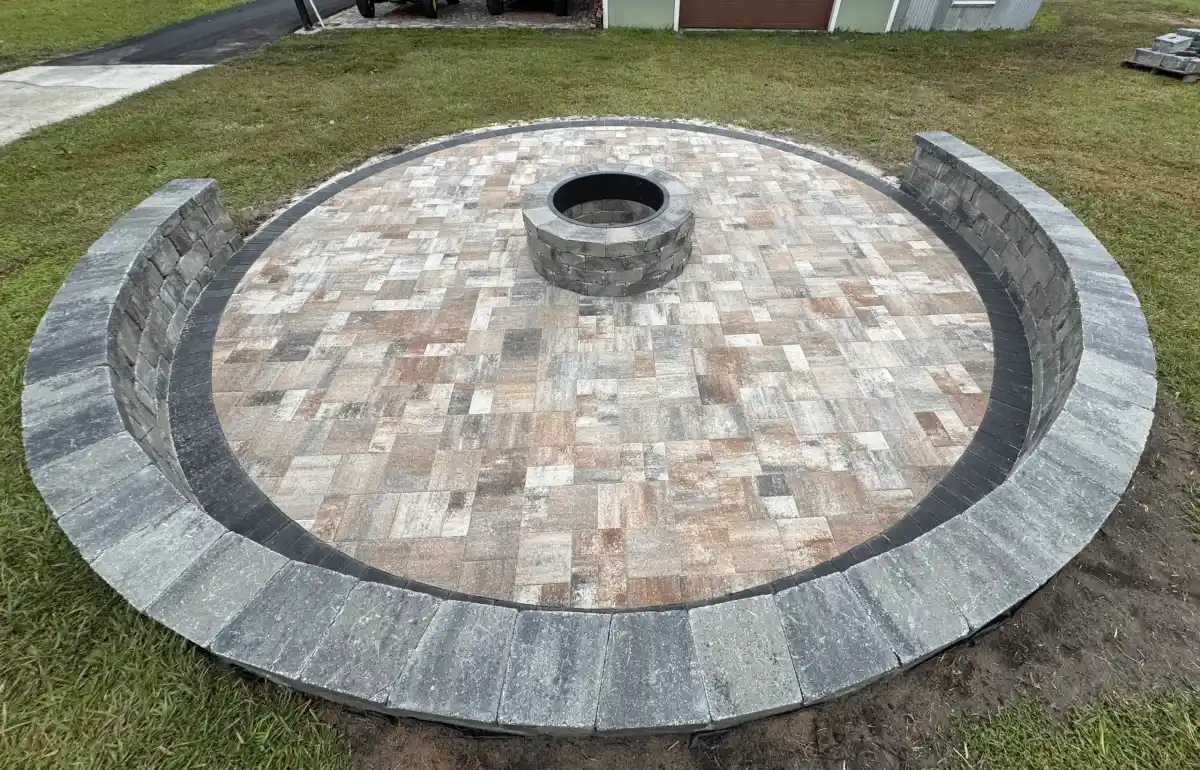
For a Citrus County home, that typically means a main seating area large enough for the gatherings you actually host, a defined space for a grill or outdoor kitchen if that’s part of the plan, and some thought given to where a fire feature fits relative to seating. Fire pits and fire tables aren’t just decorative in November and December — when temperatures drop into the 50s on clear nights, they’re the reason people stay outside instead of heading in after dinner.
Lighting is the piece most homeowners underestimate until they’re sitting outside at 7 p.m. in October and realize the sun goes down earlier than it did in July. Landscape lighting along walkways, in planting beds, and around the patio perimeter extends the usable hours of the space significantly — and it changes how the whole yard feels after dark.
One thing worth thinking through early in the design process is how the patio connects to the house. A paver walkway that leads naturally from a back door or sliding glass door to the main seating area makes the space feel intentional rather than dropped in the yard. That connection also matters for drainage — water that sheets off the house during a storm needs somewhere to go that isn’t pooling under your pavers.
If you’re starting from scratch or redesigning an existing space, the design conversation should happen before any materials are selected. The layout drives the material choices, not the other way around. A contractor who starts by asking how you use your backyard is one who’s thinking about the right things.
Not all paver materials perform equally in Florida’s climate, and the difference matters more here than it would in a drier, more temperate region. The combination of UV intensity, humidity, and the volume of organic debris that lands on outdoor surfaces — leaves, algae, pollen — means that material selection and surface protection are both part of the equation.
Concrete pavers from manufacturers like Tremron, Belgard, and Flagstone are engineered specifically for Florida’s conditions. These aren’t generic big-box pavers. They’re designed with the heat, the moisture cycling, and the ground movement that comes with sandy soil in mind. We have access to their full material lines and the installation training that comes with those partnerships — which matters when you’re making a decision that’s meant to last 20 years or more.
The surface protection piece is where a lot of homeowners get caught off guard. Unsealed pavers in Citrus County fade from UV exposure faster than most people expect. They develop algae and moss in shaded or humid areas. They lose joint sand during heavy rains, which is what allows weeds to take root between pavers. And they stain from organic material in ways that become harder to address the longer they’re left.
Professional-grade sealing — specifically Seal ‘n Lock, which we distribute exclusively in Citrus County — addresses all of those issues at once. It locks in the joint sand, creates a barrier against UV fading and staining, and makes the surface significantly easier to clean. We’re the only contractor in the county with access to Seal ‘n Lock products, which means if you want that level of protection on your pavers, there’s one place to get it.
Fall is actually the ideal time for sealing. Sealer needs dry conditions and lower humidity to cure correctly — exactly what Citrus County gets from October onward after the rainy season winds down. Sealing pavers that are still damp or in high-humidity conditions traps moisture and causes the sealer to fail. Timing matters.
Want live answers?
Connect with a MainStreet Landscaping expert for fast, friendly support.
If you already have a patio, the question isn’t whether it needs attention after summer — it almost certainly does. Citrus County’s rainy season runs from June through the end of November, and by the time October arrives, most outdoor surfaces have been through five months of heavy rainfall, high humidity, and whatever tropical weather came through.
The good news is that most patios don’t need to be replaced — they need to be restored. Cleaning, joint sand repair, and professional sealing can bring a faded, stained, or weed-invaded patio back to something close to original condition. The key is knowing what you’re actually looking at before assuming the worst.

This is one of the most common questions we hear from homeowners in Citrus County, and the answer usually surprises people: more often than not, what looks like a paver problem is actually a maintenance problem.
Fading is the most obvious sign that sealer has worn off. Florida’s UV exposure is intense, and without a protective layer, the color in concrete pavers breaks down over time. A surface that looks washed out compared to how it looked when it was installed isn’t necessarily damaged — it may just need a thorough cleaning and a fresh coat of sealer to bring the color back.
Weeds growing between pavers are almost always a joint sand issue. When the polymeric sand between pavers washes out during heavy rains, it creates an open channel where weed seeds can germinate. The fix isn’t to pull weeds indefinitely — it’s to restore the joint sand and seal the surface so the sand stays in place.
Settled or uneven pavers are a different situation. If individual pavers have dropped or shifted, that’s a base issue, and it needs to be addressed before sealing makes any sense. The good news is that one of the advantages of paver surfaces over poured concrete is that individual pavers can be lifted, the base corrected, and the pavers reset — without tearing out the entire surface.
Staining from algae, rust, or organic material is usually treatable with professional cleaning before sealing. The sequence matters: clean first, assess the joint sand, repair any settled areas, then seal. Doing it out of order — sealing over a dirty or compromised surface — locks in the problems instead of solving them.
If you’re not sure which category your patio falls into, a professional assessment before fall entertaining season is worth the conversation. What looks like a replacement situation from a distance is often a restoration situation up close.
If you don’t have a patio yet — or if what you have isn’t worth restoring — the timing question becomes about installation rather than maintenance. And the answer for Citrus County is the same: late summer and early fall is the window.
Here’s why. Contractor schedules for October and November installations start filling in August and September. Homeowners who wait until they can feel fall in the air are often looking at a December or January completion date — which means missing Thanksgiving, the holiday season, and the first two months of Citrus County’s best outdoor weather. The homeowners who are sitting on a finished patio in October are the ones who had the conversation in August.
The installation process itself also benefits from fall conditions. Lower humidity and reduced rainfall after hurricane season mean fewer weather delays, better curing conditions for base materials, and ideal timing for the sealing step that follows installation. A paver patio installed and sealed in October is starting its life under the best possible conditions.
From a financial standpoint, outdoor living investments in this climate carry real weight. A well-designed patio adds an estimated 8 to 10 percent to home value, and patio projects have been documented to return more than 100 percent of construction cost in some markets — particularly in warm-weather states where outdoor spaces are usable year-round rather than sitting dormant half the year.
In Citrus County, where 85 percent of residents own their homes and the outdoor lifestyle is genuinely central to why people choose to live here, a quality outdoor space isn’t a luxury upgrade — it’s a reasonable expectation. The Nature Coast draws people who want to be outside. The springs, the rivers, the Gulf proximity — that’s the backdrop. Your backyard is where the day-to-day version of that lifestyle actually happens.
A patio that’s built right, sealed properly, and designed for how you actually use your space is one of the more straightforward investments a Citrus County homeowner can make.
Fall in Citrus County is short in the best possible way — it arrives in October and stays comfortable well into spring. But it doesn’t wait for anyone. If your outdoor space isn’t ready when the weather shifts, you’ll spend the best months of the year looking at a patio that needs work instead of using one that doesn’t.
Whether that means cleaning and sealing what you already have, repairing settled pavers before the first gathering, or starting fresh with a design that finally matches how you want to use your backyard — the time to figure that out is now, not after the season has started.
We’ve been doing this work in Citrus County since 1995. We’ve seen what holds up through Florida’s summers and what doesn’t. We know the soil conditions in Homosassa, Crystal River, and Inverness, and we know how to build a base that handles them.
If you’re in Citrus County and you want to talk through what your outdoor space actually needs, reach out to Mainstreet Landscaping. We’ll give you a straight answer.
Article details:
Share:
Continue learning: